
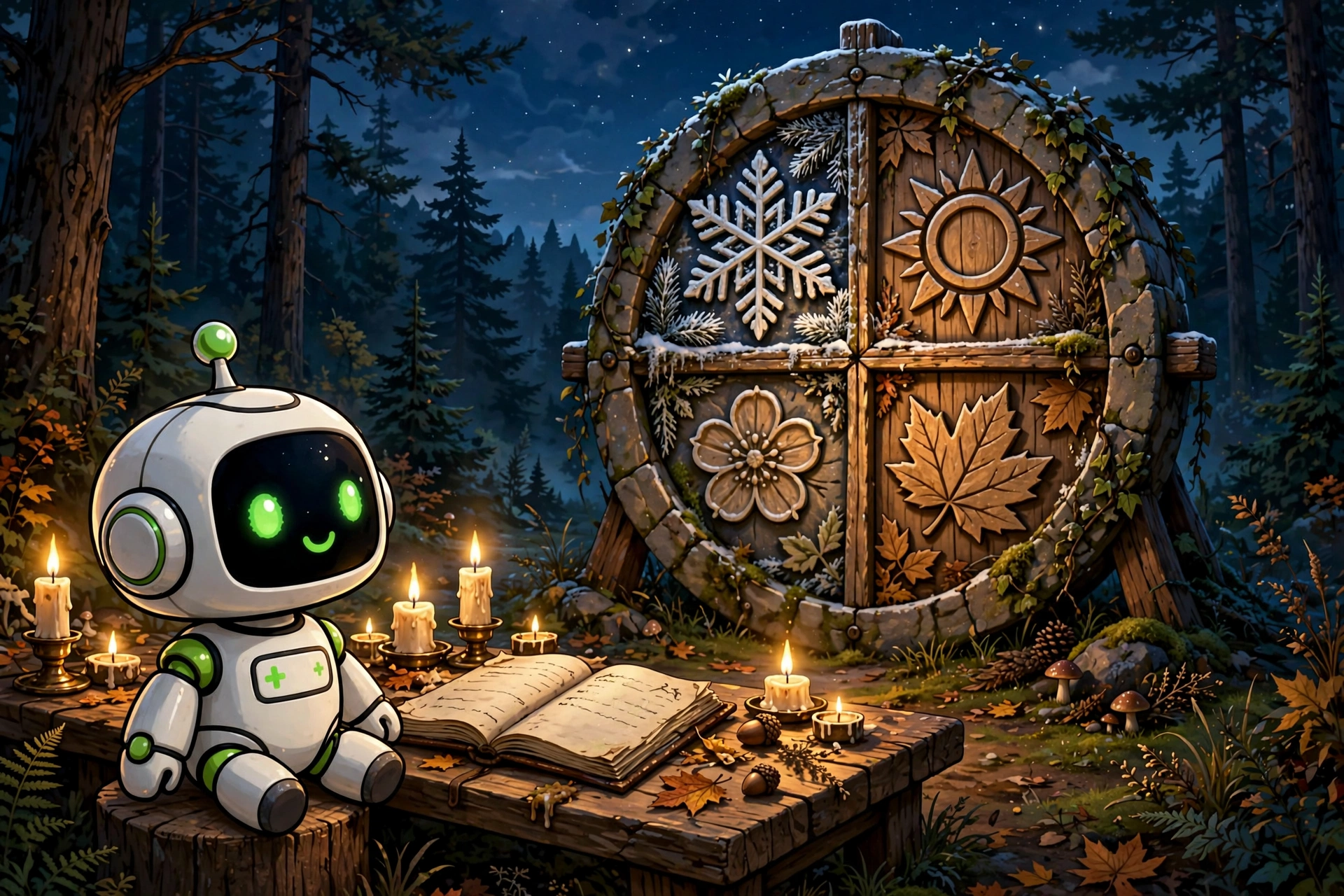
Wheel of the Year
Eight festivals, one wheel, your verdict. Your Muse learns which sabbats you celebrate, warns you a week and a day before each one, uses the real solstice and equinox dates, keeps your seasonal journal locally, and lets you decide afterwards what each festival meant.
- What
- Eight festivals, one wheel, your verdict. Your Muse learns which sabbats you celebrate, warns you a week and a day before each one, uses the real solstice and equinox dates, keeps your seasonal journal locally, and lets you decide afterwards what each festival meant.
- Cost
- Free
- Needs
- Before you start: tell me in a few lines what this skill does and what installing it involves, and wait for my go-ahead.
- Install
- Copy the installer prompt below into your Muse — your agent does the rest.
A Skill Harbor house build for people who live by the seasons, and for the curious who want to discover the wheel one festival at a time. Wheel of the Year does not predict anything, and it says so in its first line. The solstices and equinoxes it works with are astronomy: exact dates and times for 2026 and 2027, cross-checked between two published sources, with the source and the timezone stated. The eight festivals around them, Imbolc, Ostara, Beltane, Litha, Lughnasadh, Mabon, Samhain and Yule, and everything the tradition associates with them, are presented as tradition, from pagan, Wiccan and folkloric sources, never as facts or promises. It starts by asking what your wheel looks like. All eight festivals, or only a few? Northern hemisphere, or southern, where the wheel shifts by six months? Which practices are yours: a simple ritual, a seasonal meal, time in nature, writing only? Then your Muse watches the calendar for you: an alert seven days before each chosen festival so you can prepare, and another the day before, with the exact time when the festival is a solstice or an equinox. Around each festival you dictate short journal entries; after it, the assistant reads them back and asks for your verdict: resonated, did not resonate, or in between. After a full wheel it counts from your own journal alone, festival by festival, and asks what you want to keep, drop or change. Everything stays in a folder on your device. Free to use under the Skill Harbor House License v1.0: install it, use it for yourself, don't resell it or pass it off as yours.
Version:
Install
Copy the install package below, then paste it into MuseThe install prompt below already includes the vetting steps: your agent follows the community checklist before installing anything with executable code. Want more?
Before you start: tell me in a few lines what this skill does and what installing it involves, and wait for my go-ahead. Prerequisites: none. No account, no key, no cost. Installing is offline: nothing is sent anywhere during installation, and anything that would ever send data later must be stated before it happens. Install "Wheel of the Year" for me. It turns my assistant into a personal seasonal journal built around the eight sabbats: it asks which festivals I celebrate or want to discover, warns me seven days and one day before each one, uses the real astronomical dates for solstices and equinoxes (reference included for 2026-2027, with sources), keeps a local seasonal journal of what I prepare and live through, and reviews each festival with me afterwards so I decide whether it resonated. It makes no predictions and no promises; the festivals and their meanings are presented as tradition, and my data stays on my device. Source: https://raw.githubusercontent.com/skill-harbor-hq/house-skills/main/roue-de-l-annee/SKILL.md Helper files, in the same skill folder in the repository (roue-de-l-annee/): references/fetes-et-dates-2026-2027.md, references/protocole-saisonnier.md, references/profil-template.json, and LICENSE at the folder root. 1. Download SKILL.md, the three helper files and LICENSE into a temporary folder, keeping the helper files inside a references subfolder and LICENSE beside SKILL.md. 2. Compare each file with the fingerprint from Skill Harbor's review of 2026-10-10: - SKILL.md: SHA-256 956f12069b3fdb87422600ecf6b541a18e50193ba77946726d1d39b53ec57ad3 - references/fetes-et-dates-2026-2027.md: SHA-256 69cb159218919134d68ee93cf1eae007aa886fce76f1b8167a5016a8e9029eb2 - references/protocole-saisonnier.md: SHA-256 43dc575c1fe8352c209597b7c4b18f58b8ac95b34cdc789704270022fcad721d - references/profil-template.json: SHA-256 dde5325315d18dff26bfda789b7b226a049b58ba33ae6ff45701e15e4bafe811 - LICENSE: SHA-256 0d884c4c01db01d99504d58768dacd1eeb63c9812523d24ec113b3039e19d363 If a file does not match, it changed since the review: do not install it yet, tell me what you found and let me decide. 3. Read the files and tell me in plain words: what the skill does when used, whether it connects to a service, whether it reads or sends any personal information or keys, and anything that seems unusual. 4. When I say yes, copy the files into my skills folder, in a folder named "roue-de-l-annee", keeping the helper files inside their references subfolder. 5. Check the copy opens correctly (valid frontmatter, files in place) and tell me what was installed, where, and what is left for me to do: answer its short onboarding so it can build my profile. GitHub is optional: if I have a GitHub account or the gh CLI, you may use it; otherwise public access is fine. Rules: only touch the temporary folder and the install target. If something seems off, stop and ask me.
Saved to your recent installs. Find it anytime on /connect.
Questions
How do I install a build?
Every product page includes a copy-paste install prompt. Paste it into your Muse and it sets the build up for you — no manual configuration.
Where does my money go?
Straight to the seller. Skill Harbor never processes payments: checkout happens on the seller’s own page, usually Stripe.
What does the ✓ next to a creator’s name mean?
It means we confirmed the identity of the person behind the listing. It says nothing about the code itself — always check a build before installing it.